Thursday, July 2, 2020
NPCs
When you call someone an NPC, you are essentially saying that their behaviour is easy to program. It should be noted that the easiest behaviour to program is a person who is always passive.
Thursday, May 7, 2020
Solid capital
GDP is supposed to measure the economic activity in a country. The degree to which GDP manages to do that is not going to be discussed here. We will just assume that GDP is simply a fair measure of what it purports to measure, namely the total value produced in a country during a year. Rather, it is the logical leap from "economic activity" to "wealth" that I have a problem with. Wealth, in contrast to activity, is not a measure of intensity, but it is an accumulative measure. If we want to measure wealth however, we need to look at not only production of value, but also deterioration.
To take an example, say South Korea produces 100 million smartphones one year, valued at $100 each. Total value is $10 billion. In Germany on the other hand, let's say that 100 000 houses are built, valued at $100 000 each. That is not accounting for the land value, but only for the value of the structure. Nevertheless, total value is $10 billion here as well. In both cases, this economic activity adds $10 billion to the respective country's GDP. As far as economic activity goes, I suppose that I can't deny that the these two activities represent roughly the same value. The difference becomes obvious however, when we move 5 years into the future. What are the smartphones worth now? If the smartphone has been used, we can get maybe 20% of the original value. If not, and it's a model that has not entirely gone out of fashion, then maybe 50%. The houses on the other hand, need only 1-4% annual maintenance to stay fresh [1]. The equivalent maintenance rate for the smartphones would be 20%, if there was a business for smartphone upkeep.
So there is a big value term that is missing from GDP, namely how much value that is destroyed by wear and tear each year. Why is this important? The accumulated value is important when we're not just using economics to measure geopolitical johnsons, but when we're thinking about what it is that we actually want the economy to produce for us. And that is not only fast consumption goods, but also real estate, roads, railroads, water supplies, and power plants. The quality of the solid capital in one's country has a large impact on how wealthy it feels. And good quality solid capital is not only important for the feeling of well-being, but it is also the best insurance against crises. Imagine a country with no solid capital whatsoever. All their real estate is literally air castles, inflated by foreign companies for a rental fee. The water pipes and power lines are likewise rented from an entrepreneur. Come a global finance winter, and these people are sitting on the bare ground within a year!
This example is obviously a hypothetical extreme. How close do we get to this in reality? Apparently, Dubai does not have a network sewage system for their skyscrapers, but rely on septic tanks and regular offloading by trucks [2]. I can't universally diss this system: it has no pipe ruptures, that might render whole blocks without sewage, instead of just single skyscrapers. Actually, the downside of this system is mainly in the normal case: the cost of renting dozens of truck drivers regularly must be much higher than paying a couple of guys to do regular maintenance on pipes and be on standby for ruptures. But fair enough; for these rich people, the extra cost is not so painful. However, such systems are not only for the very rich: it can also be a poverty trap. In Mexico City, for example, major parts of the population rely on water tankers to supply their needs [3]. In the case of Mexico City, however, there is a municipal water system, but it is leaky for large-scale engineering reasons [4]. In Slagskuggan (1969), Swedish author Sven Lindqvist points out that the great tragedy of Latin America is that unemployment is sky high, while at the same time the there is no shortage of work to be done; the countries badly need roads, hospitals, and schools. All these examples go under the label "underinvestment in solid capital".
So much for underinvestment. What other problems are there with ignoring the value of solid capital? One problem is that if governments use GDP as their compass, then it is very easy for them to miss that their country is quietly losing wealth. If the population also happens to be highly educated so that they also look at GDP rather than at the ground in front of their feet, then even the people can miss this. In a country where a measure of the solid capital is not a part of the evaluation of governments, a government can balance a poor budget by shuffling over long-term costs to future voters. In this way, deterioration can be hidden for decades, while on paper it looks like the economy is growing. There is a saying that when a measure becomes a target, then it becomes a bad measure (because people will start to hack it). This has surely happened to GDP at this point.
Let us also look at an example of successful solid capital investment. Consider the value added to the European continent by landscaping over the last 1000 years. Barely a stone lies there, or a tree grows there, except that it is for the service of humans.
Now for the self-criticism. Is there such a thing as overinvestment in solid capital? One example I can think of is Göta Kanal, a canal which was built from 1810 to 1832. It connects the Swedish west coast to the east coast. The point of this was to reduce travel time from industries on the east coast to the Atlantic, and to avoid Danish tolls. The problem is that the canal was almost immediately rendered obsolete by the railroad [5]. The Danish tolls were also abolished in 1857 (upheld since the 1400s, the tolls disappeared soon after the US refused to pay) [6].
Herein lies the problem with solid capital: if its original use is obsoleted, then the possibilities of using it for something else are often limited, and the value decreases. Solid capital can also have a negative value by being in the way, such as a defensive wall around a city, after it is made obsolete by modern gunnery.
It is ironic that Göta Kanal, a large investment in solid capital, was made obsolete by the railroad, another large investment in solid capital. The case of the cannons vs walls is more asymmetric. In another asymmetric example, the growth on Amazon and other online retail shows that investments in physical retail can be disrupted by on-demand services. At the same time, the dominance of Amazon itself compared to other online retail, is in large due to large investments in solid capital by managing their own fulfillment centers [7][8].
One final note about the completeness of solid capital as a measure of wealth. An arguably even more important hidden value term is institutional and human capital. Both are very hard to measure directly. What is the economical value of having the world's best schools, for example? The value of a country's schools in terms of added human capital can be measured indirectly with a large time lag (about 15 years), and even then it is very uncertain what the value added by the school is. Schools deteriorate very slowly and silently (the students can't vote, and don't have a reference frame), so of course they are underinvested in.
Let us end by saying something actionable. How to avoid the trap of underinvesting in solid capital? (Not to mention institutional and human capital). Should we rely less on electable politicians to take decisions about long-term investments? Maybe shift those decisions off to experts? That strategy is itself vulnerable to institutional rot, however, and when that happens it creates popular rage and it's very hard to fix from within a democratic system (actually, from within any political system). The one action that seems most positive to me is to just start measuring the solid capital, and to start using this measure as part of the conversation. Perhaps as an extended GDP, that also included deterioration of capital. If this measure becomes an often-used figure to compare countries, then undoubtedly governments will also try to hack it. Still, it should attract investment to more long-term projects.
References
[1] Annual house maintenance
[2] Dubai sewage trucks
[3] Mexico City water tankers
[4] Mexico City water infrastructure
[5] Göta Kanal wikipedia
[6] Öresundstraktaten wikipedia
[7] The Everything Store (2013 book)
[8] All about lean: fulfillment centers
To take an example, say South Korea produces 100 million smartphones one year, valued at $100 each. Total value is $10 billion. In Germany on the other hand, let's say that 100 000 houses are built, valued at $100 000 each. That is not accounting for the land value, but only for the value of the structure. Nevertheless, total value is $10 billion here as well. In both cases, this economic activity adds $10 billion to the respective country's GDP. As far as economic activity goes, I suppose that I can't deny that the these two activities represent roughly the same value. The difference becomes obvious however, when we move 5 years into the future. What are the smartphones worth now? If the smartphone has been used, we can get maybe 20% of the original value. If not, and it's a model that has not entirely gone out of fashion, then maybe 50%. The houses on the other hand, need only 1-4% annual maintenance to stay fresh [1]. The equivalent maintenance rate for the smartphones would be 20%, if there was a business for smartphone upkeep.
So there is a big value term that is missing from GDP, namely how much value that is destroyed by wear and tear each year. Why is this important? The accumulated value is important when we're not just using economics to measure geopolitical johnsons, but when we're thinking about what it is that we actually want the economy to produce for us. And that is not only fast consumption goods, but also real estate, roads, railroads, water supplies, and power plants. The quality of the solid capital in one's country has a large impact on how wealthy it feels. And good quality solid capital is not only important for the feeling of well-being, but it is also the best insurance against crises. Imagine a country with no solid capital whatsoever. All their real estate is literally air castles, inflated by foreign companies for a rental fee. The water pipes and power lines are likewise rented from an entrepreneur. Come a global finance winter, and these people are sitting on the bare ground within a year!
This example is obviously a hypothetical extreme. How close do we get to this in reality? Apparently, Dubai does not have a network sewage system for their skyscrapers, but rely on septic tanks and regular offloading by trucks [2]. I can't universally diss this system: it has no pipe ruptures, that might render whole blocks without sewage, instead of just single skyscrapers. Actually, the downside of this system is mainly in the normal case: the cost of renting dozens of truck drivers regularly must be much higher than paying a couple of guys to do regular maintenance on pipes and be on standby for ruptures. But fair enough; for these rich people, the extra cost is not so painful. However, such systems are not only for the very rich: it can also be a poverty trap. In Mexico City, for example, major parts of the population rely on water tankers to supply their needs [3]. In the case of Mexico City, however, there is a municipal water system, but it is leaky for large-scale engineering reasons [4]. In Slagskuggan (1969), Swedish author Sven Lindqvist points out that the great tragedy of Latin America is that unemployment is sky high, while at the same time the there is no shortage of work to be done; the countries badly need roads, hospitals, and schools. All these examples go under the label "underinvestment in solid capital".
So much for underinvestment. What other problems are there with ignoring the value of solid capital? One problem is that if governments use GDP as their compass, then it is very easy for them to miss that their country is quietly losing wealth. If the population also happens to be highly educated so that they also look at GDP rather than at the ground in front of their feet, then even the people can miss this. In a country where a measure of the solid capital is not a part of the evaluation of governments, a government can balance a poor budget by shuffling over long-term costs to future voters. In this way, deterioration can be hidden for decades, while on paper it looks like the economy is growing. There is a saying that when a measure becomes a target, then it becomes a bad measure (because people will start to hack it). This has surely happened to GDP at this point.
Let us also look at an example of successful solid capital investment. Consider the value added to the European continent by landscaping over the last 1000 years. Barely a stone lies there, or a tree grows there, except that it is for the service of humans.
Now for the self-criticism. Is there such a thing as overinvestment in solid capital? One example I can think of is Göta Kanal, a canal which was built from 1810 to 1832. It connects the Swedish west coast to the east coast. The point of this was to reduce travel time from industries on the east coast to the Atlantic, and to avoid Danish tolls. The problem is that the canal was almost immediately rendered obsolete by the railroad [5]. The Danish tolls were also abolished in 1857 (upheld since the 1400s, the tolls disappeared soon after the US refused to pay) [6].
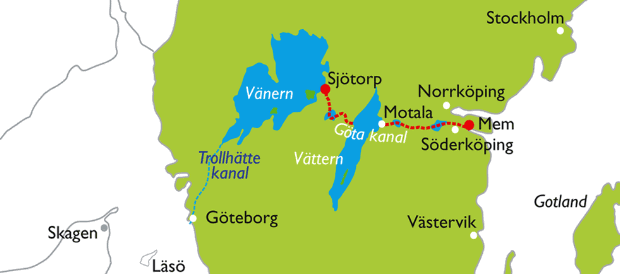 |
| Göta Kanal, an example of overinvestment in solid capital. The canal was rendered obsolete by the railroad soon after its completion. |
It is ironic that Göta Kanal, a large investment in solid capital, was made obsolete by the railroad, another large investment in solid capital. The case of the cannons vs walls is more asymmetric. In another asymmetric example, the growth on Amazon and other online retail shows that investments in physical retail can be disrupted by on-demand services. At the same time, the dominance of Amazon itself compared to other online retail, is in large due to large investments in solid capital by managing their own fulfillment centers [7][8].
One final note about the completeness of solid capital as a measure of wealth. An arguably even more important hidden value term is institutional and human capital. Both are very hard to measure directly. What is the economical value of having the world's best schools, for example? The value of a country's schools in terms of added human capital can be measured indirectly with a large time lag (about 15 years), and even then it is very uncertain what the value added by the school is. Schools deteriorate very slowly and silently (the students can't vote, and don't have a reference frame), so of course they are underinvested in.
Let us end by saying something actionable. How to avoid the trap of underinvesting in solid capital? (Not to mention institutional and human capital). Should we rely less on electable politicians to take decisions about long-term investments? Maybe shift those decisions off to experts? That strategy is itself vulnerable to institutional rot, however, and when that happens it creates popular rage and it's very hard to fix from within a democratic system (actually, from within any political system). The one action that seems most positive to me is to just start measuring the solid capital, and to start using this measure as part of the conversation. Perhaps as an extended GDP, that also included deterioration of capital. If this measure becomes an often-used figure to compare countries, then undoubtedly governments will also try to hack it. Still, it should attract investment to more long-term projects.
References
[1] Annual house maintenance
[2] Dubai sewage trucks
[3] Mexico City water tankers
[4] Mexico City water infrastructure
[5] Göta Kanal wikipedia
[6] Öresundstraktaten wikipedia
[7] The Everything Store (2013 book)
[8] All about lean: fulfillment centers
Wednesday, February 19, 2020
What defines culture
Here is a model. Culture is defined by how behaviour is evaluated. In the extreme, a culture is defined by the actions that are considered most honorable, and most shameful.
What is the consequence of this? It means the most succinct description of a culture is to say the most honorable and most shameful acts within this culture. Example, explaining hacker culture to my mom:
The most honorable thing a hacker can do is to make software that solves a problem that a lot of people (especially other hackers) have, and then give it away for free. The most shameful thing a hacker can do is to steal someone else's work and pass it off as their own. [1]
A description of science culture would be similar, replacing 'software' with 'insight'. What other cultures can we describe this way? Scouting culture:
The most honorable thing a Scout can do is to maintain a long and faithful service to the group, and to the well-being of the surrounding community and nature. The most shameful thing a scout can do is to betray the group, society at large, or destroy nature.
I would say that scouting as a culture is less self-centered than other hobby cultures, in the sense that the well-being of things outside the culture itself, weighs so heavily on the scale. If you're reading this, objecting that "my hockey team helps the homeless in the community!", then you may be right that your group cannot be called self-centered. What I would ask as a follow-up question however is: "To what extent does helping the homeless raise your status within the hockey team?" It is this internal status measuring, rather than the outside world consequences, that I'm interested in right now.
(A common theme in all cultures taken as examples so far is that altruistic behaviour to the in-group is very rewarded, and egoistic behaviour is punished. Can we think of counterexamples to this? I would say that competitive cultures such as competitive mathematics and programming, and business and law are counterexamples. In cultures like this, it can be honorable to trick or outwit someone in the in-group at their expense. However, it usually comes with some unspoken rules about what is considered fair play. The culture here is more iron-law: it is more shameful to allow oneself to be brought harm to, than to be the one who passes out the harm. Is this the default? Actually, I doubt it. The most competitive cultures have something else in common: they have an external evaluating agent. One's 'score' is not set by the peers, but by a central authority. The honor passed out by the central authority is not absolute, but relative, and therefore a finite resource. So the cruelty of the most competitive cultures is the cruelty of zero sum games. I'm making a prediction: even prehistoric nomad cultures, that occasionally attacked and killed each other, were not as competitive as Harvard Law School. The bounded consequences of competitiveness at HLS does enable more egoistic behaviour, however.)
What can we say about online culture, on say twitter or reddit? Not much in general, since the same comment can either yield praise or raise a mob depending on which subreddit/ twitter cluster it is posted. So according to this model, online culture is very fragmented, which sounds about right.
Why are honor/shame markers good definitions of culture? For one thing, they are very actionable. They tell you what to do in order to be accepted by a culture. Do the honorable things, and do not do the shameful things. It is very direct. Even if the actionability is not relevant, for example if we are investigating an ancient culture, it is still very relatable. Knowing that cattle and horse theft was considered a worse crime than manslaughter in the Old West tells us more about what life was like on the frontier than seeing a bunch of boots and revolvers, I think.
A problem with culture-as-behaviour evaluation is that it is not easy to infer from archaeological evidence. Well, measuring culture as behaviour is perhaps not a mean, but an end, for archaeology.
Let's take a negative approach for a minute and consider: what measures are bad, or inefficient, at defining a culture?
What is the consequence of this? It means the most succinct description of a culture is to say the most honorable and most shameful acts within this culture. Example, explaining hacker culture to my mom:
The most honorable thing a hacker can do is to make software that solves a problem that a lot of people (especially other hackers) have, and then give it away for free. The most shameful thing a hacker can do is to steal someone else's work and pass it off as their own. [1]
A description of science culture would be similar, replacing 'software' with 'insight'. What other cultures can we describe this way? Scouting culture:
The most honorable thing a Scout can do is to maintain a long and faithful service to the group, and to the well-being of the surrounding community and nature. The most shameful thing a scout can do is to betray the group, society at large, or destroy nature.
I would say that scouting as a culture is less self-centered than other hobby cultures, in the sense that the well-being of things outside the culture itself, weighs so heavily on the scale. If you're reading this, objecting that "my hockey team helps the homeless in the community!", then you may be right that your group cannot be called self-centered. What I would ask as a follow-up question however is: "To what extent does helping the homeless raise your status within the hockey team?" It is this internal status measuring, rather than the outside world consequences, that I'm interested in right now.
(A common theme in all cultures taken as examples so far is that altruistic behaviour to the in-group is very rewarded, and egoistic behaviour is punished. Can we think of counterexamples to this? I would say that competitive cultures such as competitive mathematics and programming, and business and law are counterexamples. In cultures like this, it can be honorable to trick or outwit someone in the in-group at their expense. However, it usually comes with some unspoken rules about what is considered fair play. The culture here is more iron-law: it is more shameful to allow oneself to be brought harm to, than to be the one who passes out the harm. Is this the default? Actually, I doubt it. The most competitive cultures have something else in common: they have an external evaluating agent. One's 'score' is not set by the peers, but by a central authority. The honor passed out by the central authority is not absolute, but relative, and therefore a finite resource. So the cruelty of the most competitive cultures is the cruelty of zero sum games. I'm making a prediction: even prehistoric nomad cultures, that occasionally attacked and killed each other, were not as competitive as Harvard Law School. The bounded consequences of competitiveness at HLS does enable more egoistic behaviour, however.)
What can we say about online culture, on say twitter or reddit? Not much in general, since the same comment can either yield praise or raise a mob depending on which subreddit/ twitter cluster it is posted. So according to this model, online culture is very fragmented, which sounds about right.
Why are honor/shame markers good definitions of culture? For one thing, they are very actionable. They tell you what to do in order to be accepted by a culture. Do the honorable things, and do not do the shameful things. It is very direct. Even if the actionability is not relevant, for example if we are investigating an ancient culture, it is still very relatable. Knowing that cattle and horse theft was considered a worse crime than manslaughter in the Old West tells us more about what life was like on the frontier than seeing a bunch of boots and revolvers, I think.
A problem with culture-as-behaviour evaluation is that it is not easy to infer from archaeological evidence. Well, measuring culture as behaviour is perhaps not a mean, but an end, for archaeology.
Let's take a negative approach for a minute and consider: what measures are bad, or inefficient, at defining a culture?
Monday, February 17, 2020
The Value of Formalization
Suppose someone hires us to solve a problem that is currently being solved by trial and error, rules of thumb, or by professional tradition. We are supposed to solve this using math, or programming, or something similar. Or as we say between you and me: using formal methods. Here is a naïve description of where the value comes in to the problematic system when using a formal approach:
First, we take a description of the problem and turn it into an equation, or whatever. Then we calculate the logical consequence of the equation and Oh My God: look at the Result! Now we know; we put this piece of information back into our process helps us save money.
Today, the "equation" part is almost always realized as software. But the thinking still applies: the value is expected to come at the end. Here is a more realistic version of what happens:
First, we take a description of the problem and turn it into an equation, but wait... this description contains a lot of holes. It's not that the computer has a hard time crunching the numbers, it's that we can't even tell it what to do in the first place. The way the problem is currently understood makes no sense, logically. Parts of the process that are thought to be clearly prescribed by rules actually require a lot of human judgement and discretion to work, and this is a large variational factor in practice. Before we can even begin to optimize this in software, we need to gain a more exact understanding of the process than anyone has had before.
In this version, the value starts coming in at the beginning, and it's a different kind of value. A better understanding of one's process is not always actionable. On the other hand, it can be actionable in very unexpected and profitable ways. Knowledge has that property. Currently, knowledge has to pass through a person's brain to have a chance at being used at its full value. So when given the task of formalization, take the chance to discover something new about a familiar process. It's often not an option.
First, we take a description of the problem and turn it into an equation, or whatever. Then we calculate the logical consequence of the equation and Oh My God: look at the Result! Now we know; we put this piece of information back into our process helps us save money.
Today, the "equation" part is almost always realized as software. But the thinking still applies: the value is expected to come at the end. Here is a more realistic version of what happens:
First, we take a description of the problem and turn it into an equation, but wait... this description contains a lot of holes. It's not that the computer has a hard time crunching the numbers, it's that we can't even tell it what to do in the first place. The way the problem is currently understood makes no sense, logically. Parts of the process that are thought to be clearly prescribed by rules actually require a lot of human judgement and discretion to work, and this is a large variational factor in practice. Before we can even begin to optimize this in software, we need to gain a more exact understanding of the process than anyone has had before.
In this version, the value starts coming in at the beginning, and it's a different kind of value. A better understanding of one's process is not always actionable. On the other hand, it can be actionable in very unexpected and profitable ways. Knowledge has that property. Currently, knowledge has to pass through a person's brain to have a chance at being used at its full value. So when given the task of formalization, take the chance to discover something new about a familiar process. It's often not an option.
Thursday, February 6, 2020
What to remember
Prioritize Invariance
Donald Trump is president.
An example of a statement that will always be true:
Donald Trump was elected president of the USA in 2016, and as of the 5th of February 2020, he held the position.
So a statement that is not invariant can be made invariant by specifying a context to it. Why prioritize invariance? Simply put: so that you can trust your own memory. If you do not couple a conclusion with its assumptions in memory, you may miss when the assumptions change, and your knowledge is outdated. If you go to the movies and see The Wolf of Wall Street and come out unhappy, something like this can easily become a cached decision:
I do not like The Wolf of Wall Street. I will not agree to rewatch it.
Consider specifying this as an observation (about yourself) instead:
When I came out of the cinema after seeing The Wolf of Wall Street, I remember feeling that the movie was too long. Also, the main character seemed unbelievable in the final 45 minutes.
Suppose now that you are offered by a friend to rewatch The Wolf of Wall street some years later. The friend has a re-edit of the film with a shorter ending, that is meant to be more true to what really happened. With the first, emotion-based memory, you would not notice that this re-edit addresses exactly the issues you had with the movie. Furthermore, remembering things this way makes your opinions more interesting to others, since they are less subjective. Remembering reasons rather than personal general impressions makes it possible for people who hear your opinion to determine whether it applies to them as well. This is an example where the consequences are of little significance of course, but suppose the same thinking is applied to for example one's impression of a person, a new piece of technology, a travel destination, a political party, or a potential employer! One could easily miss things becoming desirable (or undesirable), despite having seen enough evidence to change one's opinion.
Years
When opening a book, the first thing one should do is to check the year of publication. Why? If you know the year of publication, you know the information that was available to the author when writing the book. How do you know what information was available in such and such a year? By knowing the year of publication of other books! So by remembering a linear amount of information (i.e. one integer per book), it becomes possible to consider a quadratic number of connections (i.e. between any pair of books).
The same argument can be applied to people (knowing their birth and death year) and movies (year of release). I have found it less useful to remember years for music. Perhaps it is because I do not know enough music, so that I have not been able to see the effects of the quadratic number of connections. Another reason may be that since I am not trained in music, I do not realize that there is an interesting connection between two songs. In that case, becoming more learned in music would open up a world of interesting observations and conversation topics for me. A third possibility is that the people who do claim that there are interesting connections between different pop music songs for example, are just kind of faking it. But even with this suspicion, it might be worth it to practice a better ear for music.
Another field where I do not find it particularly useful to remember years, is in technology. There are some key inventions such as the transistor in 1947, that one should know. A reason why it is not so useful to remember certain years is that the important inventions were often created over some time. So an approximate year or decade is fine. Big inventions also take time to reach their potential. An example is the transistor radio that was released in 1954, seven years after the transistor was invented. The first neural network was demonstrated by Frank Rosenblatt in 1958. But of course, the neural network was not very important until 2012. Another reason why years are not so important for inventions is that it is more specific to remember things about the invention itself, that explain why they were able to replace the previous way of doing things. The problem with the 1958 neural network was that it lacked multilayeredness and backpropagation. This was fixed around 1978. The next missing features to greatness for neural networks was perceptive fields and layerwise training, which was introduced in the early 1990s and 2006 respectively. The final touch was data augmentation, and increasing the total amount of data and training by a lot, which was done in 2012 after which the big break finally came.
Location
When someone tells me about a new development, one of the first things I ask is: who is doing this? Which company or university? This is often ignored in a news report of the new finding. The news segment may say "Italian researchers demonstrate such-and-such". Knowing that they are Italian is not enough: it is just as well to remember the university and/ or city. Why do I insist on this?
One reason is it is more useful for networking. If you do read a good article from the University of Milan for example, and later meet someone in your field who studied in Milan, chances are quite good that they have met the authors of the article! This helps you ask more informed questions. It also shows that you have bothered to remember something related to them. In the best case they want to pay back in kind by asking about your research.
However, I think the most important reason for remembering things by location, has to do with the concept of a mind palace. The idea of a mind palace is that you imagine this place with lots of different objects and textures and levels and whatnot, and you use the image of this place to connect different memories to each object. To me, using a mind palace seems so bogus. It seems totally arbitrary. Better then to connect things to an image that is not arbitrary at all: the map of the world! The world map is something that should be remembered anyway, so it costs very little extra. It also works well on different resolutions: one will know about more things in one's home country, but one also has a better idea of the geography of one's home country.
Using the historical timeline as a third dimension to this world map-mind palace does also work very well. I don't see how it is possible to organize memories without having a good visualization of the historical timeline.
Skeptical and Charitable
It is important to be skeptical. Being skeptical means that you do not accept things on hearsay. You do not accept a statement that contradicts your present beliefs without a demonstration that proves it. To a skeptical person, a proof is necessary. A person who is not sufficiently skeptical will accumulate false beliefs. Carrying a lot of false beliefs leads to contradictions in beliefs. Being used to contradictions makes you less sensitive to them. This makes it harder to notice important contradictions. Not being able to notice important contradictions makes it even harder to be skeptical. So it is a vicious cycle. A bad model of the world makes updating your model of the world harder, so be careful about what you put in yours.
Being charitable means that you are willing to accept a statement that contradicts your current beliefs, if given a demonstration. To a charitable person, a proof is sufficient. A person who is not sufficiently charitable will ignore data that contradicts their beliefs, despite there being good reason to accept the data. Such a person can miss good opportunities. So being charitable is also important.
Notice the two logical statements above:
So to a person who is both skeptical and charitable, beliefs are based the proofs that they have seen.
What if every time we were faced with an opportunity to choose to be skeptical, a red screen would flash saying "maybe you shouldn't believe this"? And what if every time we were faced with an opportunity to be charitable, a green screen would flash saying "maybe you should believe this"? In practice, one of the signs may fail to light up. If both signs fail to light up and we just ignore the data, what happens then? What is the default? Skeptical. Skeptical is the default. A person who ignores all data is trivially a skeptic.
Does that mean that if being skeptic is the default, should we make an effort to be more charitable, even if that means accepting some false beliefs? I think not. Having bad beliefs is worse than having no beliefs, because of the vicious cycle effect. Imagine being in a plane that is about to land in Stockholm, Arlanda. The captain says that they have lost the map they have of Arlanda, so instead they will use a map they have of Copenhagen, Kastrup. You would rather they just looked out the window then!
So much for the tradeoff between skepticism and charitability. Let's focus on increasing the total sum of them! How can we do this with limited resources of mental energy? An obvious thing that people don't do enough is "just google it". Especially things that have been believed for a long time, that one picked up on hearsay. Such cached beliefs can make one look very stupid, since it is so easy to look them up these days. Ok, suppose we are on google. Which source do we believe? Answer: the most upstream one. In matters of science, always go to the original article. In matters of politics and such, who to trust about who-said-what? Answer: don't bother with who-said-what.
Is the original article the most upstream source in science? No, the most upstream source is nature herself. Nature is the final arbiter, and I don't mean the journal. Asking nature is quite expensive in general. In programming and mathematics, we are more lucky. We can go through the proof step by step by ourselves, and check that everything is right. In programming, one can implement the algorithm, and check that the output is correct. Just checking the output from examples is worth less than a full proof. However, with a paper proof, there is the problem of self doubt: did I miss something? Currently, I have a higher confidence in the computer carrying out logical operations, than in myself.
Being charitable means that you are willing to accept a statement that contradicts your current beliefs, if given a demonstration. To a charitable person, a proof is sufficient. A person who is not sufficiently charitable will ignore data that contradicts their beliefs, despite there being good reason to accept the data. Such a person can miss good opportunities. So being charitable is also important.
Notice the two logical statements above:
- If skeptical, then proof is necessary.
- If charitable, then proof is sufficient.
So to a person who is both skeptical and charitable, beliefs are based the proofs that they have seen.
What if every time we were faced with an opportunity to choose to be skeptical, a red screen would flash saying "maybe you shouldn't believe this"? And what if every time we were faced with an opportunity to be charitable, a green screen would flash saying "maybe you should believe this"? In practice, one of the signs may fail to light up. If both signs fail to light up and we just ignore the data, what happens then? What is the default? Skeptical. Skeptical is the default. A person who ignores all data is trivially a skeptic.
Does that mean that if being skeptic is the default, should we make an effort to be more charitable, even if that means accepting some false beliefs? I think not. Having bad beliefs is worse than having no beliefs, because of the vicious cycle effect. Imagine being in a plane that is about to land in Stockholm, Arlanda. The captain says that they have lost the map they have of Arlanda, so instead they will use a map they have of Copenhagen, Kastrup. You would rather they just looked out the window then!
So much for the tradeoff between skepticism and charitability. Let's focus on increasing the total sum of them! How can we do this with limited resources of mental energy? An obvious thing that people don't do enough is "just google it". Especially things that have been believed for a long time, that one picked up on hearsay. Such cached beliefs can make one look very stupid, since it is so easy to look them up these days. Ok, suppose we are on google. Which source do we believe? Answer: the most upstream one. In matters of science, always go to the original article. In matters of politics and such, who to trust about who-said-what? Answer: don't bother with who-said-what.
Is the original article the most upstream source in science? No, the most upstream source is nature herself. Nature is the final arbiter, and I don't mean the journal. Asking nature is quite expensive in general. In programming and mathematics, we are more lucky. We can go through the proof step by step by ourselves, and check that everything is right. In programming, one can implement the algorithm, and check that the output is correct. Just checking the output from examples is worth less than a full proof. However, with a paper proof, there is the problem of self doubt: did I miss something? Currently, I have a higher confidence in the computer carrying out logical operations, than in myself.
Tuesday, December 31, 2019
The Missing Arrows
How to read a model chart
What is the problem with this picture?
First some translation. "Hållbarhet" means Sustainability. The other circles say, in clockwise order, "economical", "technological", "cultural", and "social". The boxes say, in clockwise order, "values", "knowledge", "skills", "ecological method".
The graph is a mess. Can we be specific about why it is a mess? First, there is a feeling of confusion. How is this to be interpreted? Are the "values" only related to "economy" and "technology", and not to "sociality" and "culture"? That seems like an odd point to make. And "skills" is not linked to "technology". My dominant hypothesis is that the words in the boxes have been thrown in at random.
Second, the what do we learn from this? We learn that Sustainability affects the Economy, and that the Economy affects Sustainability. Okay? And not only that: Sustainability affects all the other circles, and is in turn affected by all of them. All the arrows are also the same size, so all the interaction are given equal importance. What does it even mean to say that Sustainability affects Culture? The graph leaves this as an exercise to the reader. The cooperative reader will certainly come up with some interaction and be content. What has the cooperative reader learnt? To fantasize.
The problem with the graph is that everything affects everything. Any experience or observation that the reader has about an interaction between two of these concepts will fit into the model. The reader will not reject the graph based on experiment: it permits everything.
When reading a chart, pay attention to which arrows are missing. The missing arrows are what make the actual claims. In science, a model with many nodes and few arrows eliminate a large part of the hypotheses, which make for more powerful predictions. In engineering, a design with few interactions between different parts makes for a system that is easier to maintain and modify.
An example of a good model with only a couple of clear interactions is the Central Dogma of molecular biology:
What claim is made here? That DNA does not produce proteins directly, but that the information goes via RNA first. It also claims that information is never added to DNA, except at replication. Another claim is that RNA and proteins do not replicate.
This model was falsified by experiment. It turns out that RNA sometimes does replicate by itself. And also that RNA can sometimes write to DNA. Perhaps not the way a human engineer would have done it, but we want to describe nature well, so the arrows have to be added.
How to start the scientific revolution
The enlightenment was about striking arrows, not adding them. Striking the arrow from morality to disease was the foundation of medicine. Striking the arrow from planetary movements and theology to the outcome of games of chance was the foundation of the mathematics of probability. Striking the "transmutation" arrows from elements to other elements was the foundation of chemistry. Striking the arrows between human relationships and financial transactions was the foundation of economics, a less successful example.
How to use your time with an expert efficiently
Geology - always lower = older?
(suppose we chance upon a geologist)
Astronomy - assume that stars will move in a strictly periodic pattern? This is what tells planets apart.
Demography - humans are born, grow up, have children, and die - in a quite predictable pattern!
Ecology - what species do not interact directly?
How to ask questions in order to find out these hidden reductionist assumptions in different fields? [1] First of all, we should find out whether this field and this person is actually committed to being consistent. If the field makes no solid predictions and the person is agreeable, then we should be able to make them agree to pretty much any absurd hypothesis. If the field makes no predictions and the person is disagreeable, then we are dealing with a game of Mao. Mao is a card game where the rules are being made up on the fly by the game leader, the chairman. The chairman punishes transgressions of rules that have never been spoken. The disagreeable but scientifically empty field is just politics and fashion. The fiercest players win, instead of the most correct hypotheses. So as a way of finding out the truth, it serves no purpose.
Suppose now that we have good reason for believing that our expert will not agree to anything, but will also not discard our arguments simply on the basis of coming from an outsider. So the expert will treat our arguments skeptically but charitably. Now we have the basis for actually exchanging knowledge. How should we proceed to find the reductionist assumptions in the field? The problem is that these assumptions may not be so conscious for the expert. It does also not make for interesting conversation to simply ask directly "what are the hidden reductionist assumptions in your field?". One thereby misses a chance to prove to the expert that one is worthy of their best response. A clever person finds a way to find out the hidden assumptions with questions that seem to be leading a different way at first.
[1] Why even ask a person at all? Why can't we google it? This is the type of thing that is typically hard to find in written sources. Another problem is that before knowing a subject's hidden reductionist assumptions, basically nothing one reads within the subject makes deep sense.
 |
What is the problem with this picture?
First some translation. "Hållbarhet" means Sustainability. The other circles say, in clockwise order, "economical", "technological", "cultural", and "social". The boxes say, in clockwise order, "values", "knowledge", "skills", "ecological method".
The graph is a mess. Can we be specific about why it is a mess? First, there is a feeling of confusion. How is this to be interpreted? Are the "values" only related to "economy" and "technology", and not to "sociality" and "culture"? That seems like an odd point to make. And "skills" is not linked to "technology". My dominant hypothesis is that the words in the boxes have been thrown in at random.
Second, the what do we learn from this? We learn that Sustainability affects the Economy, and that the Economy affects Sustainability. Okay? And not only that: Sustainability affects all the other circles, and is in turn affected by all of them. All the arrows are also the same size, so all the interaction are given equal importance. What does it even mean to say that Sustainability affects Culture? The graph leaves this as an exercise to the reader. The cooperative reader will certainly come up with some interaction and be content. What has the cooperative reader learnt? To fantasize.
The problem with the graph is that everything affects everything. Any experience or observation that the reader has about an interaction between two of these concepts will fit into the model. The reader will not reject the graph based on experiment: it permits everything.
When reading a chart, pay attention to which arrows are missing. The missing arrows are what make the actual claims. In science, a model with many nodes and few arrows eliminate a large part of the hypotheses, which make for more powerful predictions. In engineering, a design with few interactions between different parts makes for a system that is easier to maintain and modify.
An example of a good model with only a couple of clear interactions is the Central Dogma of molecular biology:
 |
| The central dogma of molecular biology |
 |
| The extended central dogma. |
How to start the scientific revolution
The enlightenment was about striking arrows, not adding them. Striking the arrow from morality to disease was the foundation of medicine. Striking the arrow from planetary movements and theology to the outcome of games of chance was the foundation of the mathematics of probability. Striking the "transmutation" arrows from elements to other elements was the foundation of chemistry. Striking the arrows between human relationships and financial transactions was the foundation of economics, a less successful example.
How to use your time with an expert efficiently
Geology - always lower = older?
(suppose we chance upon a geologist)
Astronomy - assume that stars will move in a strictly periodic pattern? This is what tells planets apart.
Demography - humans are born, grow up, have children, and die - in a quite predictable pattern!
Ecology - what species do not interact directly?
How to ask questions in order to find out these hidden reductionist assumptions in different fields? [1] First of all, we should find out whether this field and this person is actually committed to being consistent. If the field makes no solid predictions and the person is agreeable, then we should be able to make them agree to pretty much any absurd hypothesis. If the field makes no predictions and the person is disagreeable, then we are dealing with a game of Mao. Mao is a card game where the rules are being made up on the fly by the game leader, the chairman. The chairman punishes transgressions of rules that have never been spoken. The disagreeable but scientifically empty field is just politics and fashion. The fiercest players win, instead of the most correct hypotheses. So as a way of finding out the truth, it serves no purpose.
Suppose now that we have good reason for believing that our expert will not agree to anything, but will also not discard our arguments simply on the basis of coming from an outsider. So the expert will treat our arguments skeptically but charitably. Now we have the basis for actually exchanging knowledge. How should we proceed to find the reductionist assumptions in the field? The problem is that these assumptions may not be so conscious for the expert. It does also not make for interesting conversation to simply ask directly "what are the hidden reductionist assumptions in your field?". One thereby misses a chance to prove to the expert that one is worthy of their best response. A clever person finds a way to find out the hidden assumptions with questions that seem to be leading a different way at first.
[1] Why even ask a person at all? Why can't we google it? This is the type of thing that is typically hard to find in written sources. Another problem is that before knowing a subject's hidden reductionist assumptions, basically nothing one reads within the subject makes deep sense.
Subscribe to:
Posts (Atom)