Monday, September 7, 2020
A heuristic for finding interesting places to walk
When going away from home: bias towards the smaller road. To find the way back: bias towards the bigger.
Sunday, August 30, 2020
Economics of geeks and hipsters
People want as much out of life as possible. One way of doing that is to maximize lifetime earnings. Another way is to maximize consumer surplus. When a marginal increase in earnings become too costly in time and energy, it is more efficient to start increasing consumer surplus. This leads to fragmentation of how people consume things. Hipsters and geeks are examples of this. The markets also respond by fragmentation.
Consumer surplus is the maximum price you would pay for a thing, minus what you actually paid for it. A person who likes standard milk chocolate, loves it even more than expensive chocolate, makes a killing in terms of consumer surplus, since milk chocolate is quite cheap. Appreciating second hand apparel could likewise make living in a first world country satisfying and affordable at the same time. Or old vinyl records. So that's an economic rationale for hipster culture. The advantage of consuming forgotten things (that are still commercially available) disappear when those things become retro, and price increases. A hipster who buys an overpriced item has in a sense failed (if the item was actually unappreciated, then it wouldn't be expensive). Then, that person is not a hipster but just someone who follows fashion.
Now to geek culture. Being a geek is about doing one thing intensively at the expense of ignoring other things to the point that the it becomes problematic or embarrassing [1]. Sacrifice plays a part in geekiness. Hipsters don't want others infringing on their thing because it decreases consumer surplus, and geeks don't want it because it decreases the value of something that they have sacrificed for. When this happens, geeks either shrug and keep doing their thing (may be a sign of social illiteracy), or move into even geekier territory. This creates a market for even more specialized things.
[1] Famous people who became famous through their own efforts are geeks who were lucky enough to be geeky about something that others became interested in later. Applies to arts, including science and development.
Tuesday, August 18, 2020
Bottom-up and Top-down
The great insight in the theory of natural selection is that nature is bottom-up optimized rather than top-down optimized.
A bottom-up optimizing system is characterized by local equilibrium equations. A top-down optimizing system is characterized by a global objective function.
Top-down paradigms are popular among both scientists and mythologists. Here is an anecdote told by my astronomy professor. Why does Jupiter have so many moons? Top-down philosophers in the 1600s said that the reason is that the people on Jupiter are great scholars who like to read at night, and the many moons are there to provide them with plenty of reading light around the clock!
It takes a great effort to wean oneself from the impulse to apply top-down optimizing models to systems that are actually bottom-up. Genetic populations are bottom-up optimized. A genetic population stops evolving when there is no variation in the population that has a higher or lower relative fitness. This is not the same as the population having achieved perfection in any sense. Likewise, a variation that has a high relative fitness in the population, at the expense of decreasing the fitness of the species as a whole, can still prosper.
Free markets are also bottom-up optimized. A market stops developing when there is no way to get an investment to create a company (or modify an existing one) that will produce the product with a margin that will yield a higher return on investment than the current interest rate. This is not the same as optimally converting given limited resources into the product.
Now we get to looser ground. Something I've learned in my working life is that large organizations are also bottom-up optimized. A large organization stops changing when there are no changes that can be done within any manager's budget that will increase that manager's power. This is not the same as the company producing its product optimally. It's not entirely true that large corps are bottom-up. There can still be heroic figures who do things that help the company that get ignored, or worse. Small companies have a coordination boost relative to large companies because "stuff that increases an employee's status" and "stuff that is good for the company" are much easier to align in small companies than in large ones.
So, can markets and large organizations be made to behave in a more top-down manner? Yes, if they are in the presence of a large source of energy. The word energy will have to do here, for lack of a better word. For the market and the organization, the best example of an energy source is an unexploited innovation. In the presence of many great unexploited innovations, bottom-up systems can behave in a very harmonious and coordinated way. When the innovations run out, chaos, inefficiency, and stasis returns.
Something that should always be asked: what does the above model of reality predict and, more importantly, what does it prohibit? First of all, this should reduce our trust in institutions that were put in place during great ages of innovation. It's possible that they were always broken, but that their brokenness wasn't noticed because everyone was high on innovation-dope.
The most important use of the bottom-up view is as a tool to analyse possibly broken organisations. When looking at an organisation we can ask "is this organisation behaving as if it had a single goal, or is it behaving as if it consisted of several semi-independent parts with possibly contradictory objectives?". The most apparent red flag is that one part of the organisation is working against another part. Another red flag is that one part is impeded by another part for a long period of time.
Philosophy test
A single question test to determine whether someone has a philosophical mindset.
The question is: "Where would you like to go, if you could go anywhere?"
Failing answers include: Athens, Boston, Mars. Any specific location.
A person who likes thinking, and who plays around with ideas all the time, will recognise the question as being very underspecified. What is meant by "going"? Is it by conventional travel or through magic teleportation? Can any equipment be brought? Is the return trip included in the hypothetical offer? Can one stay for an unlimited time?
Asking for clarification like this is necessary to make sure that the inquirer and respondent are both agreed on what is being asked. The asking of clarification questions is also an opportunity for the inquirer to be surprised: the respondent may have thought about something that the inquirer did not. A clarification process like this is such a valuable feature of dialogue, and it can be done in a few seconds.
A tip to feel more at home in a new neighborhood
Suppose you are walking in a neighborhood that you have moved to recently. You still feel like a stranger. A way to marginally overcome that feeling is to pick up a small piece of litter, and throw it in a wastebin. Preferably something that is not too icky, but say a dry ice cream paper. If you do this, you will feel a little bit of ownership of the place.
This has worked for me several times. Other people are convinced as well.I recently took a walk in the neighborhood of my new office. I found a large piece of cardboard on the street. I tucked it in behind a wastebin so it wouldn't blow away, and kept walking. After about 20 meters, and old lady stopped me and asked about where to find a parking meter. "I'm afraid that I don't live here", I answered. "Really?", she said with surprise "it looked like you did".
Thursday, July 2, 2020
NPCs
When you call someone an NPC, you are essentially saying that their behaviour is easy to program. It should be noted that the easiest behaviour to program is a person who is always passive.
Thursday, May 7, 2020
Solid capital
GDP is supposed to measure the economic activity in a country. The degree to which GDP manages to do that is not going to be discussed here. We will just assume that GDP is simply a fair measure of what it purports to measure, namely the total value produced in a country during a year. Rather, it is the logical leap from "economic activity" to "wealth" that I have a problem with. Wealth, in contrast to activity, is not a measure of intensity, but it is an accumulative measure. If we want to measure wealth however, we need to look at not only production of value, but also deterioration.
To take an example, say South Korea produces 100 million smartphones one year, valued at $100 each. Total value is $10 billion. In Germany on the other hand, let's say that 100 000 houses are built, valued at $100 000 each. That is not accounting for the land value, but only for the value of the structure. Nevertheless, total value is $10 billion here as well. In both cases, this economic activity adds $10 billion to the respective country's GDP. As far as economic activity goes, I suppose that I can't deny that the these two activities represent roughly the same value. The difference becomes obvious however, when we move 5 years into the future. What are the smartphones worth now? If the smartphone has been used, we can get maybe 20% of the original value. If not, and it's a model that has not entirely gone out of fashion, then maybe 50%. The houses on the other hand, need only 1-4% annual maintenance to stay fresh [1]. The equivalent maintenance rate for the smartphones would be 20%, if there was a business for smartphone upkeep.
So there is a big value term that is missing from GDP, namely how much value that is destroyed by wear and tear each year. Why is this important? The accumulated value is important when we're not just using economics to measure geopolitical johnsons, but when we're thinking about what it is that we actually want the economy to produce for us. And that is not only fast consumption goods, but also real estate, roads, railroads, water supplies, and power plants. The quality of the solid capital in one's country has a large impact on how wealthy it feels. And good quality solid capital is not only important for the feeling of well-being, but it is also the best insurance against crises. Imagine a country with no solid capital whatsoever. All their real estate is literally air castles, inflated by foreign companies for a rental fee. The water pipes and power lines are likewise rented from an entrepreneur. Come a global finance winter, and these people are sitting on the bare ground within a year!
This example is obviously a hypothetical extreme. How close do we get to this in reality? Apparently, Dubai does not have a network sewage system for their skyscrapers, but rely on septic tanks and regular offloading by trucks [2]. I can't universally diss this system: it has no pipe ruptures, that might render whole blocks without sewage, instead of just single skyscrapers. Actually, the downside of this system is mainly in the normal case: the cost of renting dozens of truck drivers regularly must be much higher than paying a couple of guys to do regular maintenance on pipes and be on standby for ruptures. But fair enough; for these rich people, the extra cost is not so painful. However, such systems are not only for the very rich: it can also be a poverty trap. In Mexico City, for example, major parts of the population rely on water tankers to supply their needs [3]. In the case of Mexico City, however, there is a municipal water system, but it is leaky for large-scale engineering reasons [4]. In Slagskuggan (1969), Swedish author Sven Lindqvist points out that the great tragedy of Latin America is that unemployment is sky high, while at the same time the there is no shortage of work to be done; the countries badly need roads, hospitals, and schools. All these examples go under the label "underinvestment in solid capital".
So much for underinvestment. What other problems are there with ignoring the value of solid capital? One problem is that if governments use GDP as their compass, then it is very easy for them to miss that their country is quietly losing wealth. If the population also happens to be highly educated so that they also look at GDP rather than at the ground in front of their feet, then even the people can miss this. In a country where a measure of the solid capital is not a part of the evaluation of governments, a government can balance a poor budget by shuffling over long-term costs to future voters. In this way, deterioration can be hidden for decades, while on paper it looks like the economy is growing. There is a saying that when a measure becomes a target, then it becomes a bad measure (because people will start to hack it). This has surely happened to GDP at this point.
Let us also look at an example of successful solid capital investment. Consider the value added to the European continent by landscaping over the last 1000 years. Barely a stone lies there, or a tree grows there, except that it is for the service of humans.
Now for the self-criticism. Is there such a thing as overinvestment in solid capital? One example I can think of is Göta Kanal, a canal which was built from 1810 to 1832. It connects the Swedish west coast to the east coast. The point of this was to reduce travel time from industries on the east coast to the Atlantic, and to avoid Danish tolls. The problem is that the canal was almost immediately rendered obsolete by the railroad [5]. The Danish tolls were also abolished in 1857 (upheld since the 1400s, the tolls disappeared soon after the US refused to pay) [6].
Herein lies the problem with solid capital: if its original use is obsoleted, then the possibilities of using it for something else are often limited, and the value decreases. Solid capital can also have a negative value by being in the way, such as a defensive wall around a city, after it is made obsolete by modern gunnery.
It is ironic that Göta Kanal, a large investment in solid capital, was made obsolete by the railroad, another large investment in solid capital. The case of the cannons vs walls is more asymmetric. In another asymmetric example, the growth on Amazon and other online retail shows that investments in physical retail can be disrupted by on-demand services. At the same time, the dominance of Amazon itself compared to other online retail, is in large due to large investments in solid capital by managing their own fulfillment centers [7][8].
One final note about the completeness of solid capital as a measure of wealth. An arguably even more important hidden value term is institutional and human capital. Both are very hard to measure directly. What is the economical value of having the world's best schools, for example? The value of a country's schools in terms of added human capital can be measured indirectly with a large time lag (about 15 years), and even then it is very uncertain what the value added by the school is. Schools deteriorate very slowly and silently (the students can't vote, and don't have a reference frame), so of course they are underinvested in.
Let us end by saying something actionable. How to avoid the trap of underinvesting in solid capital? (Not to mention institutional and human capital). Should we rely less on electable politicians to take decisions about long-term investments? Maybe shift those decisions off to experts? That strategy is itself vulnerable to institutional rot, however, and when that happens it creates popular rage and it's very hard to fix from within a democratic system (actually, from within any political system). The one action that seems most positive to me is to just start measuring the solid capital, and to start using this measure as part of the conversation. Perhaps as an extended GDP, that also included deterioration of capital. If this measure becomes an often-used figure to compare countries, then undoubtedly governments will also try to hack it. Still, it should attract investment to more long-term projects.
References
[1] Annual house maintenance
[2] Dubai sewage trucks
[3] Mexico City water tankers
[4] Mexico City water infrastructure
[5] Göta Kanal wikipedia
[6] Öresundstraktaten wikipedia
[7] The Everything Store (2013 book)
[8] All about lean: fulfillment centers
To take an example, say South Korea produces 100 million smartphones one year, valued at $100 each. Total value is $10 billion. In Germany on the other hand, let's say that 100 000 houses are built, valued at $100 000 each. That is not accounting for the land value, but only for the value of the structure. Nevertheless, total value is $10 billion here as well. In both cases, this economic activity adds $10 billion to the respective country's GDP. As far as economic activity goes, I suppose that I can't deny that the these two activities represent roughly the same value. The difference becomes obvious however, when we move 5 years into the future. What are the smartphones worth now? If the smartphone has been used, we can get maybe 20% of the original value. If not, and it's a model that has not entirely gone out of fashion, then maybe 50%. The houses on the other hand, need only 1-4% annual maintenance to stay fresh [1]. The equivalent maintenance rate for the smartphones would be 20%, if there was a business for smartphone upkeep.
So there is a big value term that is missing from GDP, namely how much value that is destroyed by wear and tear each year. Why is this important? The accumulated value is important when we're not just using economics to measure geopolitical johnsons, but when we're thinking about what it is that we actually want the economy to produce for us. And that is not only fast consumption goods, but also real estate, roads, railroads, water supplies, and power plants. The quality of the solid capital in one's country has a large impact on how wealthy it feels. And good quality solid capital is not only important for the feeling of well-being, but it is also the best insurance against crises. Imagine a country with no solid capital whatsoever. All their real estate is literally air castles, inflated by foreign companies for a rental fee. The water pipes and power lines are likewise rented from an entrepreneur. Come a global finance winter, and these people are sitting on the bare ground within a year!
This example is obviously a hypothetical extreme. How close do we get to this in reality? Apparently, Dubai does not have a network sewage system for their skyscrapers, but rely on septic tanks and regular offloading by trucks [2]. I can't universally diss this system: it has no pipe ruptures, that might render whole blocks without sewage, instead of just single skyscrapers. Actually, the downside of this system is mainly in the normal case: the cost of renting dozens of truck drivers regularly must be much higher than paying a couple of guys to do regular maintenance on pipes and be on standby for ruptures. But fair enough; for these rich people, the extra cost is not so painful. However, such systems are not only for the very rich: it can also be a poverty trap. In Mexico City, for example, major parts of the population rely on water tankers to supply their needs [3]. In the case of Mexico City, however, there is a municipal water system, but it is leaky for large-scale engineering reasons [4]. In Slagskuggan (1969), Swedish author Sven Lindqvist points out that the great tragedy of Latin America is that unemployment is sky high, while at the same time the there is no shortage of work to be done; the countries badly need roads, hospitals, and schools. All these examples go under the label "underinvestment in solid capital".
So much for underinvestment. What other problems are there with ignoring the value of solid capital? One problem is that if governments use GDP as their compass, then it is very easy for them to miss that their country is quietly losing wealth. If the population also happens to be highly educated so that they also look at GDP rather than at the ground in front of their feet, then even the people can miss this. In a country where a measure of the solid capital is not a part of the evaluation of governments, a government can balance a poor budget by shuffling over long-term costs to future voters. In this way, deterioration can be hidden for decades, while on paper it looks like the economy is growing. There is a saying that when a measure becomes a target, then it becomes a bad measure (because people will start to hack it). This has surely happened to GDP at this point.
Let us also look at an example of successful solid capital investment. Consider the value added to the European continent by landscaping over the last 1000 years. Barely a stone lies there, or a tree grows there, except that it is for the service of humans.
Now for the self-criticism. Is there such a thing as overinvestment in solid capital? One example I can think of is Göta Kanal, a canal which was built from 1810 to 1832. It connects the Swedish west coast to the east coast. The point of this was to reduce travel time from industries on the east coast to the Atlantic, and to avoid Danish tolls. The problem is that the canal was almost immediately rendered obsolete by the railroad [5]. The Danish tolls were also abolished in 1857 (upheld since the 1400s, the tolls disappeared soon after the US refused to pay) [6].
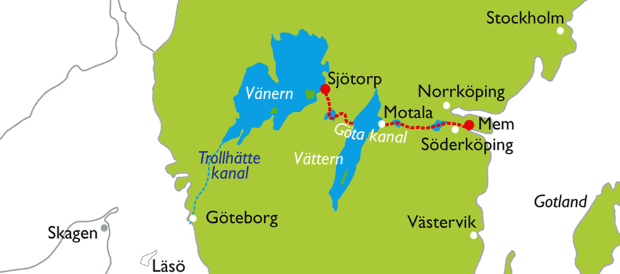 |
| Göta Kanal, an example of overinvestment in solid capital. The canal was rendered obsolete by the railroad soon after its completion. |
It is ironic that Göta Kanal, a large investment in solid capital, was made obsolete by the railroad, another large investment in solid capital. The case of the cannons vs walls is more asymmetric. In another asymmetric example, the growth on Amazon and other online retail shows that investments in physical retail can be disrupted by on-demand services. At the same time, the dominance of Amazon itself compared to other online retail, is in large due to large investments in solid capital by managing their own fulfillment centers [7][8].
One final note about the completeness of solid capital as a measure of wealth. An arguably even more important hidden value term is institutional and human capital. Both are very hard to measure directly. What is the economical value of having the world's best schools, for example? The value of a country's schools in terms of added human capital can be measured indirectly with a large time lag (about 15 years), and even then it is very uncertain what the value added by the school is. Schools deteriorate very slowly and silently (the students can't vote, and don't have a reference frame), so of course they are underinvested in.
Let us end by saying something actionable. How to avoid the trap of underinvesting in solid capital? (Not to mention institutional and human capital). Should we rely less on electable politicians to take decisions about long-term investments? Maybe shift those decisions off to experts? That strategy is itself vulnerable to institutional rot, however, and when that happens it creates popular rage and it's very hard to fix from within a democratic system (actually, from within any political system). The one action that seems most positive to me is to just start measuring the solid capital, and to start using this measure as part of the conversation. Perhaps as an extended GDP, that also included deterioration of capital. If this measure becomes an often-used figure to compare countries, then undoubtedly governments will also try to hack it. Still, it should attract investment to more long-term projects.
References
[1] Annual house maintenance
[2] Dubai sewage trucks
[3] Mexico City water tankers
[4] Mexico City water infrastructure
[5] Göta Kanal wikipedia
[6] Öresundstraktaten wikipedia
[7] The Everything Store (2013 book)
[8] All about lean: fulfillment centers
Subscribe to:
Posts (Atom)